The Secret Architecture of the Programmer’s Time Machine..
A deep dive into how Git actually works and why it completely changed the way developers build, experiment, and collaborate.
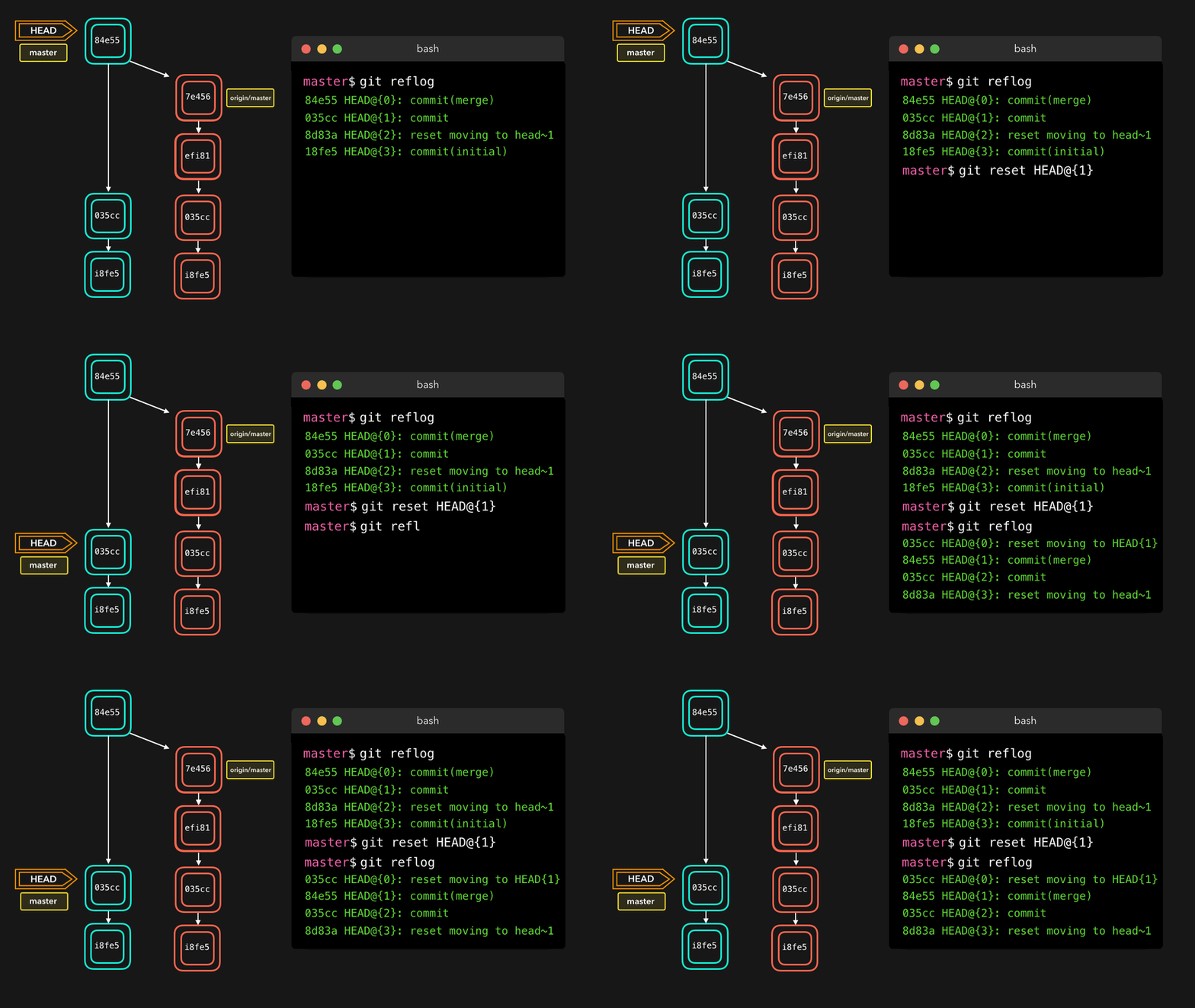
We’ve all had that moment of pure, cold panic. You’ve been coding for three hours, everything was working perfectly, and then suddenly it’s not. You try to undo your way back to safety, but you’ve gone too far. The code is a mess, and the version that worked is gone forever.
This is usually the moment we meet Git. At first, it feels like a grumpy librarian or a complex set of secret handshakes you have to memorize just to save your work. But if you step back and look at how Git is actually built, you realize it’s not just a tool. It’s a masterpiece of engineering that changed how we create things together.
The Shift from “Changes” to “Snapshots”
Most people assume that version control works like a high-end filing cabinet that tracks every tiny edit you make. Early systems actually did this; they saved a base file and then kept a long, tedious list of every “delta” or change. To see your code, the computer had to do a bunch of math to add those changes up.
Git decided to be smarter. Instead of keeping a list of chores, Git takes a “snapshot.” Every time you commit, it’s like Git takes a high-resolution photo of your entire project at that exact second. If a file hasn’t changed, Git doesn’t waste energy making a new copy — it just creates a tiny digital link back to the previous version. This is why Git is so incredibly fast. It isn’t calculating your history; it’s simply showing you a gallery of perfectly preserved moments in time.
The Digital Fingerprint
One of the most beautiful parts of Git’s design is how it identifies your work. It doesn’t care about filenames like final_version_v2.js. Instead, it uses a mathematical “hash” ($SHA-1$) to create a unique fingerprint for every single piece of data.
This is a concept called Content-Addressable Storage. Essentially, the “address” of a file is the file itself. If you change even a single comma, the fingerprint changes completely. This engineering choice provides a level of integrity that is almost poetic. It means your history is mathematically unhackable. You can trust that the code you wrote on your first day of the project is exactly as you left it, down to the last byte.
Parallel Universes on a Budget
In the old days of software engineering, “branching” or creating a separate space to experiment was a nightmare. It involved copying massive folders and crossing your fingers. Git turned this into something “cheap” and instantaneous.
In Git’s world, a branch isn’t a heavy copy of your project. It’s just a tiny pointer, a digital sticky note that says, “I’m working over here now.” Because these pointers are so lightweight, Git encourages you to be brave. You can create a “parallel universe” to try a wild new feature, and if it fails, you just delete the sticky note. Your main reality remains untouched. It’s the ultimate safety net for creativity.
Where Code Meets Community
While Git is the engine under the hood, GitHub is the road we all drive on. It’s important to remember that Git is “distributed,” meaning you own the entire history of your project on your own machine. You don’t actually need the internet to use the best parts of Git.
However, GitHub added the human element. By introducing the “Pull Request,” they turned a technical merge into a social conversation. It allowed us to stop emailing code snippets back and forth and start collaborating in a way that is transparent and organized. It’s where the “awesome engineering” of Git meets the messy, brilliant reality of human teamwork.
Why This Changed Everything for Me
When I started learning Git, I spent a lot of time feeling like I was doing it wrong. I would get stuck in “merge conflicts” and feel like the terminal was judging me. But once I understood that Git is just a series of snapshots connected in a beautiful, logical web, the fear went away.
It’s an incredible piece of engineering because it respects the creator. It gives us the freedom to mess up, the power to collaborate across oceans, and the security of knowing our history is safe. It’s more than just a “developer tool” — it’s the backbone of the modern digital world.